Car Battery Lifespan Brisbane: How Long Does It Last?
Most people only think about their car battery when it stops working. In Brisbane, that moment tends to arrive earlier than expected, and often at the worst possible time: a scorching afternoon in a shopping centre car park, or first thing in the morning when you need to be somewhere. Car battery lifespan in Brisbane is measurably shorter than in cooler climates, and if you’re not accounting for Queensland’s heat in how you choose and maintain your battery, you’re setting yourself up for a stranding. This guide covers exactly how long your battery should last, why Brisbane’s climate accelerates wear, and what you can do about it before it becomes an emergency.
Table of Contents
- Quick Takeaways
- How Long Does a Car Battery Last in Brisbane?
- Why Brisbane Heat Kills Batteries Faster
- Battery Types and How They Hold Up in the Heat
- Battery Type Comparison for Brisbane Conditions
- Warning Signs Your Battery Is Failing
- How to Extend Your Car Battery Life in Brisbane
- When to Call a Mobile Battery Service
- Frequently Asked Questions
- References
Quick Takeaways
| Key Insight | Explanation |
|---|---|
| Brisbane batteries wear out closer to 3 years | While the national average is 3 to 5 years, Brisbane’s persistent heat pushes most standard batteries toward the lower end of that range. |
| Heat is harder on batteries than cold | Contrary to popular belief, summer heat degrades batteries faster than cold weather does, accelerating internal chemical reactions and causing electrolyte evaporation. |
| AGM batteries last longer in hot climates | AGM (Absorbent Glass Mat) batteries are sealed and designed to resist heat-related water loss, making them a smarter investment for Queensland drivers. |
| Short trips are a silent battery killer | Frequent short drives do not allow the alternator enough time to fully recharge the battery, causing it to gradually lose capacity over weeks and months. |
| Test your battery at the 2-year mark | Waiting until it fails is the most expensive approach. Professional testing at two years old gives you enough warning to replace it on your terms, not the road’s terms. |
| Stop-start vehicles need specific battery types | Vehicles with stop-start technology require AGM or EFB batteries. Using a standard battery in these systems causes early failure and electrical issues. |
| Dirty terminals shorten battery life | Corrosion and loose connections force the battery to work harder, draining its capacity faster and accelerating wear on the internal cells. |
How Long Does a Car Battery Last in Brisbane?
The honest answer: plan for around three years, not five. Most car batteries in Australia are rated for three to five years, but that upper figure assumes a temperate climate and consistent driving habits. In a warm city like Brisbane, most batteries wear out closer to the three-year mark because heat accelerates the chemical processes inside the battery, steadily degrading its ability to hold and deliver a charge.
Brisbane’s subtropical climate means your battery faces above-average temperatures for much of the year, not just during summer peaks. That sustained thermal stress compounds every time you take a short trip, leave your car parked in an exposed area, or run air conditioning, reverse cameras, and charging ports simultaneously. Expecting five years from a standard lead-acid battery in Brisbane is optimistic at best, and it leaves you gambling on a part that gives very little warning before it fails completely.
The practical takeaway: if your battery is past the two-year mark and you haven’t had it tested, that test is overdue. If it’s past three years, you’re already in replacement territory whether it feels fine or not.
Why Brisbane Heat Kills Batteries Faster
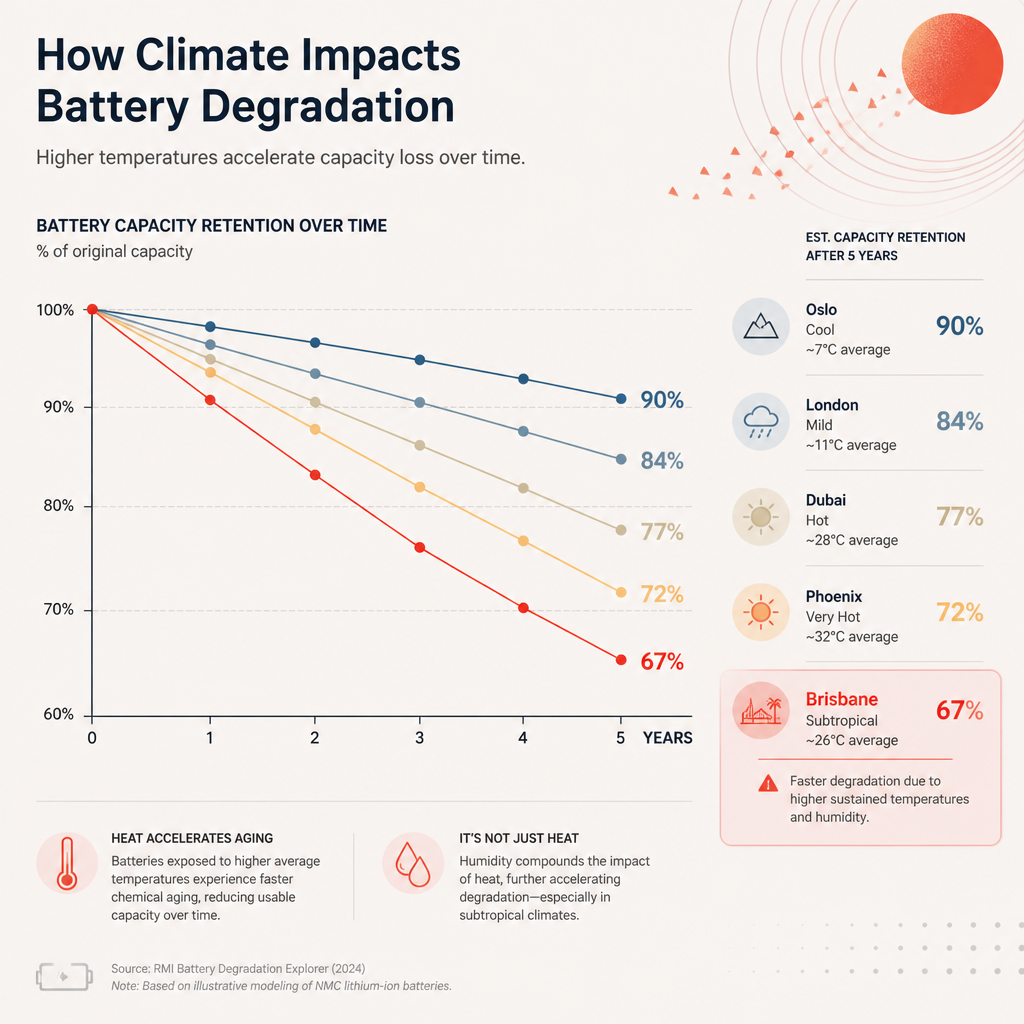
The science is straightforward. An optimal operating temperature for a car battery is around 20 degrees Celsius. Brisbane regularly pushes well above 30 degrees in summer, and the temperature under a car bonnet in direct sunlight climbs significantly higher than that. Every degree above the optimal range speeds up the internal chemical reactions inside the battery, which sounds like it might be a good thing but is actually the opposite.
For standard flooded lead-acid batteries, rising heat causes the liquid electrolyte (a mixture of water and sulfuric acid) to begin evaporating. As the fluid level drops, the internal lead plates are exposed to air, causing permanent oxidation and corrosion that reduces both capacity and cranking power. Once that damage happens, it cannot be reversed. For sealed AGM batteries, the electrolyte loss is less of an issue, but extreme heat still accelerates grid corrosion and breakdown of the active material on the plates.
Battery service life reduces at a rate of roughly 50% for every 10 degree Celsius increase above 25 degrees. A battery rated for six years at 25 degrees may only deliver three years if its operating environment averages 35 degrees throughout its life.
There is a persistent myth that cold kills batteries more than heat. In Brisbane this is essentially irrelevant because cold spells are mild by any standard. Heat is the primary enemy for Queensland drivers, and it’s the reason a battery that appears healthy in winter can fail without obvious warning as soon as summer arrives and the thermal load peaks.
The Compounding Effect of Short Trips
Brisbane’s traffic patterns make short-trip driving extremely common, and this compounds the heat problem significantly. Every time you start your engine, the battery depletes a portion of its charge. The alternator needs a sustained period of driving to replenish that charge fully. A typical commute across inner Brisbane or a quick drive to the shops and back simply doesn’t allow enough run time for a full recharge cycle.
Over weeks and months, this partial-recharge pattern leaves the battery in a permanently under-charged state, which accelerates sulfation of the internal plates. Sulfation is one of the leading causes of premature battery failure and is directly worsened by the combination of frequent short trips and high ambient temperatures.
Battery Types and How They Hold Up in the Heat
Not all batteries behave the same way in Brisbane conditions. Choosing the right battery chemistry for your vehicle and driving profile makes a measurable difference to how long it lasts before needing replacement.
Standard Flooded Lead-Acid Batteries
These are the most common type found in petrol and diesel vehicles across Australia. Under typical conditions, they last between three and five years. In Brisbane’s sustained heat, expect to land near the lower end of that range, especially if you do a lot of short-trip driving or park outdoors regularly. They are the most affordable upfront option but tend to be the most heat-sensitive.
AGM (Absorbent Glass Mat) Batteries
AGM batteries are sealed, so they do not lose electrolyte through evaporation the way flooded batteries do. They are also designed to handle the demands of vehicles with stop-start technology, regenerative braking, and high electrical loads. In standard hot-climate driving conditions, AGM batteries generally offer a longer service life, typically in the range of five to seven years, thanks to their sealed design and improved resistance to vibration and deep cycling.
They cost more upfront, but for Brisbane drivers who want to avoid a premature roadside failure, the additional investment tends to pay for itself. Brands like Delkor, Optima, and VARTA manufacture quality AGM options well-suited to Queensland conditions.
EFB (Enhanced Flooded Battery)
EFB batteries sit between standard flooded and AGM in terms of performance and price. They are specifically designed for entry-level stop-start vehicles and offer better cycling performance than a standard battery, though they do not match the heat and load resilience of a full AGM unit. If your vehicle came with an EFB from the factory, replace it with another EFB or upgrade to AGM. Dropping back to a standard lead-acid battery will cause early failure.
Pro tip: If your vehicle has a stop-start system, using a standard flooded battery instead of AGM or EFB is not a cost-saving move. It is an accelerated failure. Always match the battery technology to the vehicle’s requirements, not the cheapest available option.
Battery Type Comparison for Brisbane Conditions
| Battery Type | Typical Lifespan in Brisbane | Best For |
|---|---|---|
| Standard Flooded Lead-Acid | 2 to 3 years with heat exposure | Older vehicles without stop-start, budget replacement, lower annual mileage |
| AGM (Absorbent Glass Mat) | 5 to 7 years with proper care | Stop-start vehicles, 4WDs, caravans, marine use, high electrical load vehicles |
| EFB (Enhanced Flooded Battery) | 3 to 5 years | Entry-level stop-start vehicles, moderate electrical demand |
Warning Signs Your Battery Is Failing
Batteries rarely fail with zero warning. The problem is that most Brisbane drivers are already running hot, and the early symptoms are easy to dismiss as “probably nothing.” By the time the failure is obvious, you’re already stranded. Knowing what to look for gives you the opportunity to replace on your schedule rather than the battery’s.
Slow Engine Crank
If your engine takes longer to turn over than it used to, particularly on first start in the morning, your battery is struggling to deliver sufficient cranking amps. This is one of the clearest early indicators. Do not wait to see whether it gets worse. It will.
Dim or Flickering Headlights
Headlights that are noticeably dimmer than usual, or that flicker when you start the engine or turn on electrical accessories, indicate the battery is no longer supplying stable voltage. This is both a battery failure warning and a road safety issue.
Dashboard Warning Lights
The battery warning light or alternator symbol illuminating is an obvious flag, but it often only appears once the problem is already advanced. Also watch for unexplained electrical malfunctions: windows that move slowly, interior lights that dim when you press the brake, or infotainment systems that reset unexpectedly.
Swollen or Bloated Battery Case
A battery case that looks swollen, bulging, or distorted is a sign of heat damage. Excessive heat causes gases to build up inside the casing. A battery in this state is not just failing, it is a safety risk and needs immediate replacement.
Sulphur or Rotten Egg Smell
A strong sulphur smell near the battery indicates the electrolyte is overheating or leaking. This is a sign of a battery that has been pushed beyond its limits and is in a terminal state. Do not attempt to jump-start a battery showing visible damage or emitting unusual smells without professional assessment.
Pro tip: Have your battery load-tested, not just voltage-checked, at the two-year mark. A battery can read at adequate voltage while having lost a significant portion of its cold cranking amp capacity. Load testing reveals actual performance under start conditions, which is what matters when Brisbane temperatures peak.
How to Extend Your Car Battery Life in Brisbane
No maintenance routine will make a battery last forever, but the difference between two and a half years and four years from the same battery often comes down to a handful of consistent habits that take very little time or money.
Park in Shade or a Garage Wherever Possible
Parking under cover reduces the ambient temperature the battery operates in, which directly reduces the rate of electrolyte evaporation and chemical degradation. In Brisbane, this is not a minor benefit. Consistently parking a car in full sun versus undercover can meaningfully affect how quickly heat damage accumulates inside the battery casing.
Keep Terminals Clean and Connections Tight
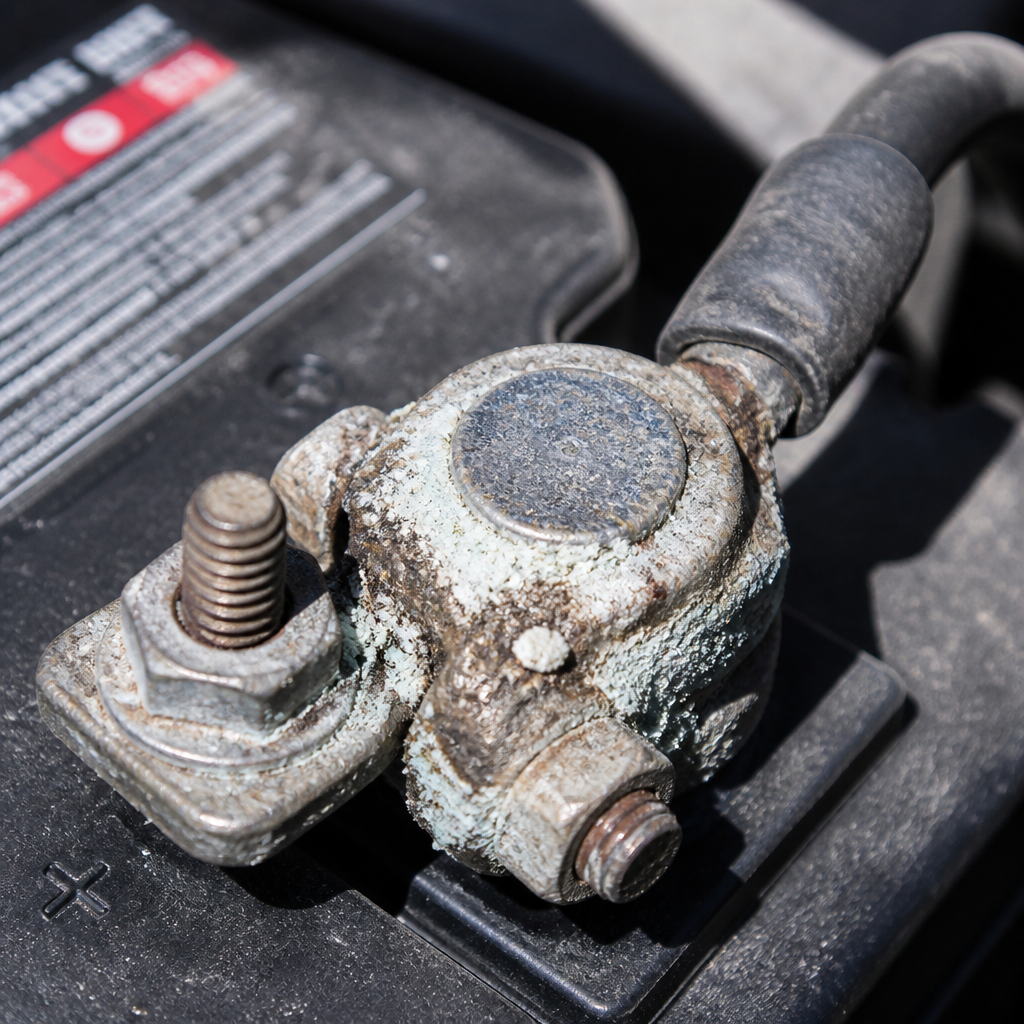
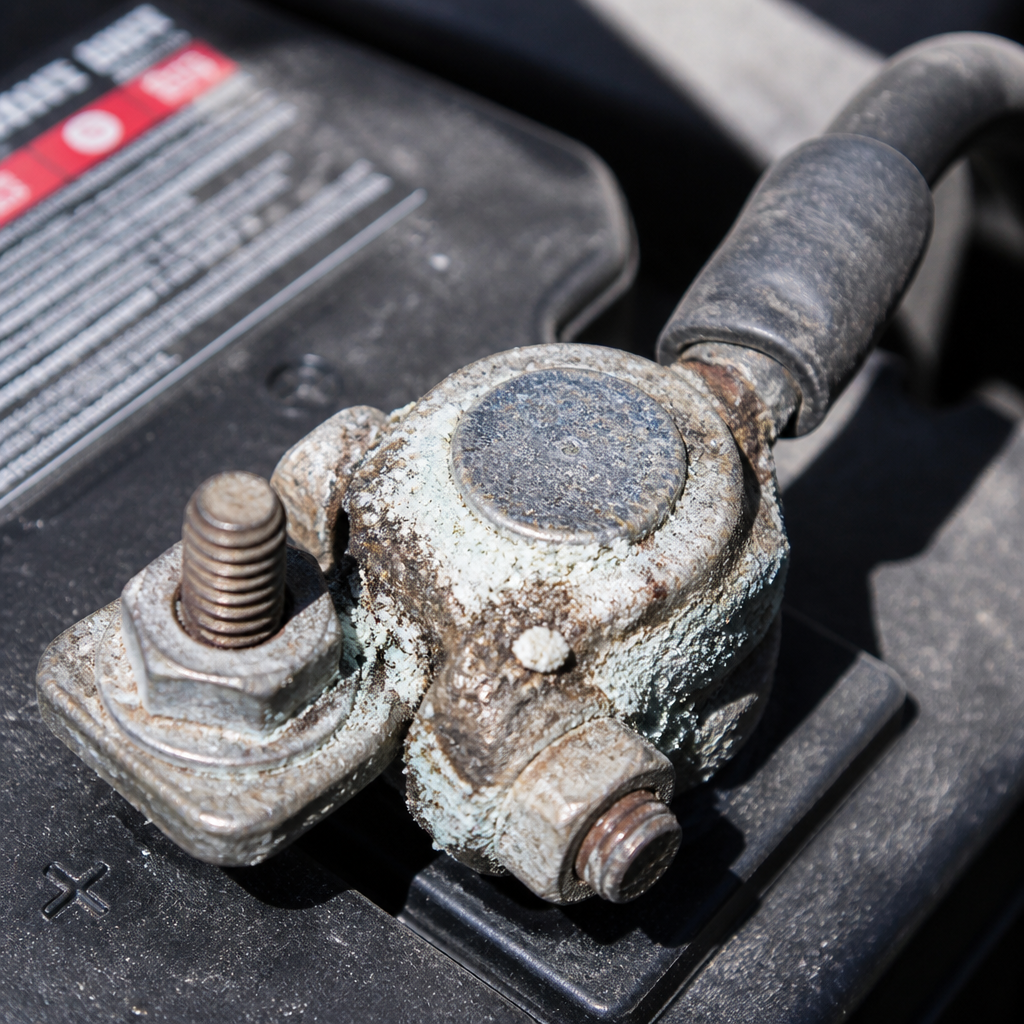
Corrosion on battery terminals creates resistance that forces the battery to work harder than necessary every time you start the car or run electrical accessories. Clean terminals with a damp cloth and a small amount of baking soda if white crystalline deposits appear. Make sure clamps are firm and not wiggling. Loose connections also allow small electrical arcs that accelerate wear.
Minimise Parasitic Drain When the Car Is Parked
Modern vehicles have a lot of systems drawing low-level power even when the engine is off: alarm systems, Bluetooth modules, GPS trackers, dashcams. If your car sits unused for extended periods, each of these slowly drains the battery. A battery maintainer or smart charger connected during long periods of inactivity keeps the battery at a healthy state of charge without overcharging it.
Service Your Alternator
A faulty alternator means the battery never fully recharges while driving, which puts it in the same partially-discharged state as frequent short trips but permanently. Signs of alternator problems include the battery warning light, flickering lights, and electrical faults when the engine is running. The battery and alternator depend on each other, and a failing alternator will destroy even a new battery given enough time.
Replace at the Right Time, Not the Last Moment
In Brisbane, three years is a reasonable trigger to start monitoring closely. Arrange a professional test, and if the battery is showing reduced capacity or failing the load test, replace it proactively. A $200 to $300 battery replacement on a Tuesday morning is a considerably better outcome than a roadside breakdown in the middle of summer traffic.
When to Call a Mobile Battery Service
There are situations where getting your car to a workshop is not realistic, and in Brisbane’s heat, this happens more often than you’d expect. If your car won’t start in your driveway, your work car park, or on the side of the road, you need a service that comes to you, not the other way around.
Battery Australia operates 24 hours a day, seven days a week across Brisbane with a 30-minute arrival guarantee. The service covers on-the-spot battery testing and replacement for cars, trucks, 4WDs, motorcycles, marine vessels, and caravans, without requiring a membership or call-out fee. The team carries stock from leading brands including Delkor, Optima, Century, and VARTA, so the right battery for your specific vehicle is fitted at the roadside rather than after a parts order delay.
For Brisbane drivers who want to avoid the stranded scenario entirely, Battery Australia’s car battery replacement service also covers proactive replacements at home or at work, on your schedule. If your battery is approaching or past three years old and you haven’t had it tested, booking a mobile test before summer peaks is the practical move. The service area covers all Brisbane suburbs, and the business commits to beating any advertised price in Brisbane, so there is no premium for the mobile convenience.
A common mistake is calling for a jump-start and assuming that solves the problem. A jump-start gets you moving, but if the underlying battery is degraded, it will fail again, often sooner and in a worse location. If you’re calling for a jump-start on a battery that is more than two years old, have it load-tested before you drive away.
Frequently Asked Questions
How long does a car battery last in Brisbane specifically?
In Brisbane’s warm subtropical climate, most standard car batteries last around two to three years before they need replacement, compared to the three-to-five-year range often cited for Australia broadly. Heat accelerates internal degradation, and if you add frequent short trips and high electrical loads, you can reach the shorter end of that range quickly. AGM batteries tend to last longer, typically five to seven years, and are a better fit for Queensland driving conditions.
Does Brisbane heat actually shorten battery life more than cold weather?
Yes, and this surprises many drivers. Heat is significantly more damaging to a car battery than cold. High temperatures speed up the chemical reactions inside the battery, cause electrolyte evaporation in flooded batteries, and accelerate plate corrosion in both flooded and AGM types. Brisbane’s mild winters pose very little risk to battery life. It’s the sustained summer heat, combined with elevated under-bonnet temperatures, that does most of the damage.
What are the warning signs that my car battery is about to die?
The most common signs are a slow engine crank on startup, dimmer or flickering headlights, unexplained electrical glitches inside the car, and a swollen or bloated battery casing. A strong sulphur or rotten egg smell near the battery is a more urgent warning that the battery is in a dangerous state. If you notice any of these symptoms on a battery that is two or more years old, arrange a professional load test or replacement promptly rather than waiting to see if it gets worse.
Can I extend my car battery life in Brisbane, or is early failure inevitable?
You can meaningfully extend battery life with the right habits. Parking in shade or a garage reduces heat exposure, keeping terminals clean eliminates resistance-related wear, and ensuring your alternator is working correctly prevents the battery from being chronically undercharged. Choosing an AGM battery from the start instead of a standard flooded battery also gives you a head start on longevity in Queensland’s climate. Early failure is not inevitable, but it does require some deliberate effort, especially during summer months.
How often should I replace my car battery in Brisbane?
Rather than replacing on a fixed schedule, the better approach is to have your battery professionally load-tested at the two-year mark and then annually after that. If the battery passes the load test, you’re fine to keep driving. If it shows significantly reduced capacity or fails the test, replace it regardless of whether it’s still starting the car. A battery that’s borderline on a test in May is a breakdown risk by January. For most Brisbane drivers, replacement somewhere between two and four years is the realistic range for standard batteries.
What is the best battery type for hot Brisbane conditions?
An AGM battery from a reputable brand is the best all-round choice for Brisbane drivers, particularly if your vehicle has stop-start technology, a high number of electronic accessories, or if you want to maximise time between replacements. Brands like Delkor, Optima, VARTA, and Century all produce AGM options suited to Australian conditions. If your vehicle came with an EFB battery from the factory, replace like-for-like or upgrade to AGM, but do not downgrade to a standard flooded battery.
Is a mobile battery replacement service worth it compared to going to a workshop?
For a car that won’t start, a mobile service is the only realistic option that doesn’t involve towing. But mobile replacement also makes sense for proactive replacements, especially if you’d rather have the job done at home or at work without rearranging your day around a workshop visit. Battery Australia comes to your location across Brisbane 24 hours a day with no membership requirement and no call-out fees, which removes most of the friction compared to traditional workshop-based replacement.
Have you dealt with a battery failure in Brisbane’s heat before? We’d love to hear when and where it caught you off guard, and what you’d do differently now.
References
- Bosch Service Brisbane guide on car battery lifespan and Brisbane climate effects
- Auto Stop breakdown of battery types and expected lifespan in hot climates
- VARTA Automotive technical article on how temperature affects battery service life
- Odyssey Battery FAQ on summer heat, battery degradation rates, and AGM advantages
- Northside Auto Brisbane guide to car battery lifespan and maintenance tips